BIBLIOGRAPHY
- Bajomi Lázár, Endre: A Quartier Latin. Budapest, 1971.
- A magyar Párizs. Edited by.: Bajomi Lázár Endre. Budapest, 1978.
- Majoros, Valéria Vanília: Tihanyi Lajos. Írásai és dokumentumok. Budapest, 2002.
- Majoros, Valéria Vanília: Tihanyi Lajos. A művész és művészete. Budapest, 2004.
- Magyar Vadak Párizstól Nagybányáig 1904–1914. (The Hungarian Fauves from Paris to Nagybánya 1904-1914) Exh. cat. Edited by.: Passuth, Krisztina, Szücs, György. Budapest, 2006.
- A Nyolcak. (The Eight) Exh. cat. Edited by: Bardoly, István, Markója, Csilla, Pécs, 2010.
- Passuth, Krisztina: Egy bohém festő Budapesten, Berlinben és Párizsban. Budapest, 2012.
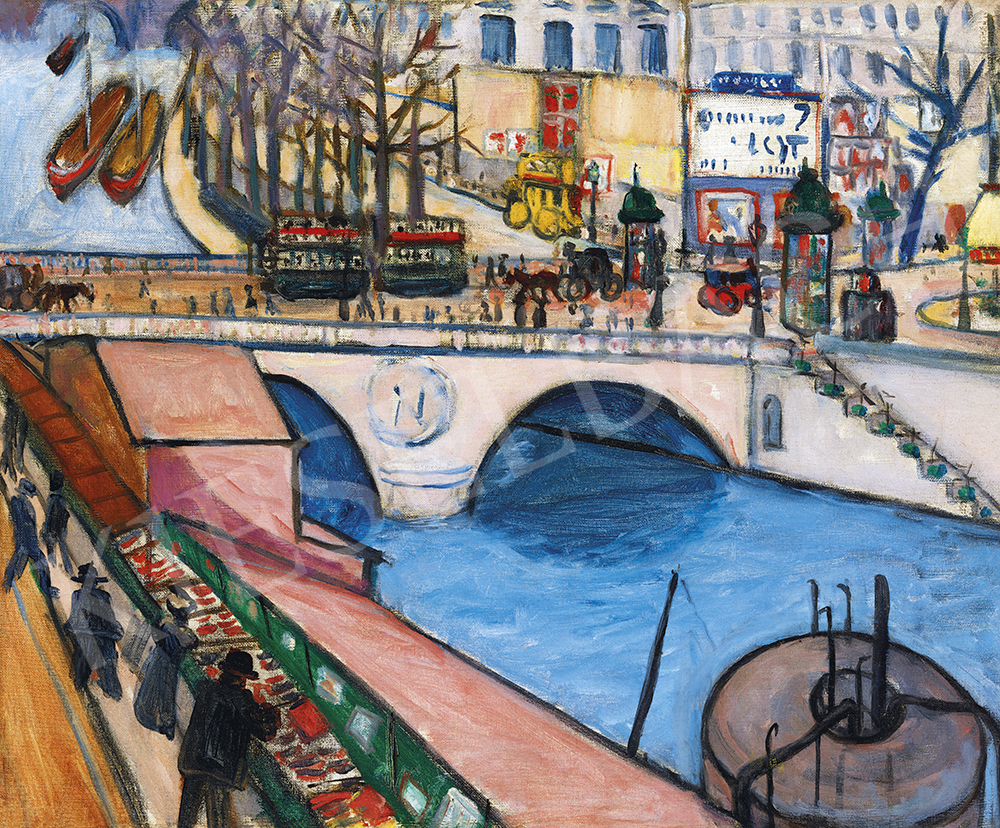
This is a rare moment: a work of art appeared after 110 years of being hidden, in untouched condition, straight from the descendants of the first owner. This painting may not only bring an extraordinary enrichment to an oeuvre, an era and an artistic trend, but it can also give a new momentum to the international career of Hungarian art. Lajos Tihanyi’s composition entitled Pont St. Michel was born at the cultic spot of Modernism, its artistic quality and the bravery of its form is a match for the internationally celebrated works of the greatest artists of the era. The beauty of the form is collated with multi-sidedness of the content because of the perfect choice of topic. It creates and ideal “entrance ticket” for those who would see this work of art from the outside, that is, without any knowledge about the history of Hungarian art, but with an eye trained on the international scene, and even those viewers would certainly evaluate it as a masterpiece coming from the “unknown”.
Independent from everything
The painter’s father, József Tihanyi (born as Teitelman) was a diligent man who had become a respectable café-owner from a simple waiter. However, his good example stood in vain in front of his son: all through his life he rebelled against everything and everybody, did not care about any social or artistic conventions, so Lajos Tihanyi most probably saw an ignorable, even condemnable family example in the bourgeois form of life and not an attractive model for himself. According to those people who were closely connected to him, he spent all his youth exclusively with painting and womanizing. Although he completely lost his hearing when he was a child (due to a serious illness) and consequently he pronounced the words with a loud and distorted intonation, he was still irresistibly attractive to most women around him as his jealous mates admitted it. These surprising successes were not set back by the fact that he was almost completely uneducated. Due to his illness, he only completed four years at school and became self-educated afterwards. He always dressed very well and was an explicit gourmand. As to his official artistic training, he attended a few semesters at the Applied Drawing School in Budapest, although in his autobiographies he referred to some painting courses dimly, however we do not know anything about them in fact. It seems that he was the least-educated but the most instinctive genius of modern Hungarian art: he was an autonomous man, a self-confident, moreover self-sufficient artist. He managed to conquer all obstacles with his brilliant talent and always in his own way.
From Nagybánya to the capital of art
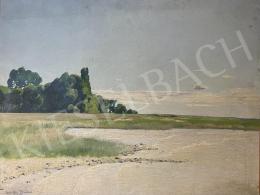
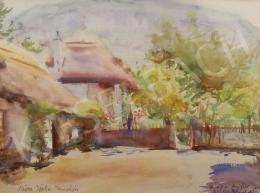
In the summer of 1907 he, as an almost completely beginner painter, travelled to Nagybánya, where he immediately met the essential stylistic elements Post-Impressionism and the Fauve art imported to Hungary by Béla Czóbel. We hardly know any of the result of the months spent here; one of them is the Garden in Nagybánya which appeared from the same collection as the one depicting the Pont Saint-Michel, after being hidden for 110 years. Apart from this landscape we can assume that three group compositions must have been born in that summer: the paintings entitled Nudes in the open-air, Adam and Eve and Bathers. All three pictures show the undeniable influence of the Gauguin exhibition in Budapest in 1907. The rest of the artworks from this time we can only know from titles: they were listed in a handwritten note that Tihanyi himself compiled in the 1930s, listing shortly the titles and the names of the former owners of the pictures.
Our knowledge about his trip to Paris after the months spent in Nagybánya is also vague. He seemed to be working in complete loneliness in the capital of modern art: his friends and colleagues never mentioned an encounter with him. Even he himself was in trouble when decades later he had to date this fate-forming trip. This study tour lasted from the end of 1907 to the spring of the next year and paintings from this period only have appeared recently. These pictures show that Tihanyi must have spent these months with finding the most perfect possible solution of one artistic issue, of course, not neglecting the obligatory, bohemian rollicking. Although it is not proved by any written source, we can quite safely assume based on the remaining paintings that he rented a flat in the street called Quai Saint-Michel, on the left bank of the Seine, between Petit Pont and the Pont Saint-Michel. Even if he did not live in this area, we can be sure that he stood his easel up here. Altogether four paintings remained from his trip to Paris in 1907–1908 and these all depicted a detail of the embankment from above and from such a perspective that could only be seen from there.
Two pictures represent the first, slightly reserved steps of the systematic preparation for the great task: one of them is the Rowers which is very decorative with its logical order and homogeneous colour spots despite of its shy composition, while the other one is the Rowers on the Seine which was sold at the auction sale last year and originally used to be in the former Gordon-Váradi collection. The latter artwork must be treated with special attention, as Tihanyi noted precisely both the time and place of its creation: „Páris 1907 Quai St Michel”. The exact address is unfortunately unknown, but we can set up a theory: Tihanyi may have rented a studio together with Gyula Andorkó who, in 1908, depicted the same sight from the same angle, almost in the same cutting but with a more small-time invention and more sober perspective. The painter had a tragic fate: he committed suicide in 1909, but in a letter one year earlier (March 24, 1908, now at the library of the Museum of Fine Arts, Budapest), he mentioned that he had stayed at a studio under 15, Quai Saint-Michel. His studio was hardly 40 metres from and a little lower than Matisse’s flat and studio on the third floor that he had been renting since 1895. Matisse often lent his window to his friend, the painter, Albert Marquet who regularly, almost in a program-like way painted the Pont Saint-Michel. It can be easily assumed that Andorkó and Tihanyi similarly shared one of the most beautiful city-scape of the world which has also reached a prominent significance in the history of the modern art.
Composition and colours
The composition is arranged around diagonal direction. The stable structural frame is based on the emphatic contours painted with black and blue paint. These contours not only compress and “moderate” the motifs, but also they enhance the colour intensity of the building elements, the individual spots of the sight laid down on plane surface. The strong contour and the pure line drawing became already fashionable back in the time of the Art Noveau and the calligraphic element integrated into the work of the most modernist artists with an unparalleled speed; due to the Europe-wide cult of Gauguin and Matisse. Tihanyi, though, could easily find examples in the Hungarian visual traditions as well. Among others, works by Károly Ferenczy or József Rippl-Rónai also praised the line drawing a couple of years ago and Tihanyi’s artworks created just one year earlier had still echoed this vocalic contouring. The Pont St. Michel painted in 1908 meant a radical proceeding in this respect as well: the sharply broken straight lines and the intentionally roughly “ripped” bows remind us much more of the elemental spontaneity and the contempt towards chiselled beauty of the Fauves than the gently curving form culture of the Art Noveau ornaments.
This artistic attitude which radiates the seemingly spontaneous free creative momentum and raw strength appears in the use of the brush which operates with well-separated colour hasps. Instead of precise, accurate trifling and learned manners we can see instinct, energy and free artistic will flowing on the painting which is a poignant work of art depicting the completeness of the moment with the enthusiasm of a fresh look. The gentle pulsation of the white canvas between the edges of the brushes and under the colours makes the composition breathing and this slight vibration is further strengthened by the throbbing bustle of motifs. Tihanyi manages to escape the trap of a certain painting method which is based on building up the composition with filling the contour with homogeneous spots. Instead, he provides the viewer with a rich sensual ammunition with the separated brushes, the continuous variation of covered and transparent surfaces as a flow or ornaments.
The essential character of the colour world of the picture is basically determined by the blue colours of the river and the pink of the architectural details. The pink, – with the apt expression by Gyula Kemény – is the jolly joker colour of the Hungarian Fauves and Neo-Impressionist Artists. This colour is estranged from Nature, so it is especially suitable to elevate the sight from reality. It is also suitable to make the viewer immediately and dramatically witness that a work of art is an abstracted, autonomous object with independent pictorial rules. Moreover, Tihanyi was aware of the fact that this popular colour that was a dominant one even in Gauguin’s painting, can be extremely effectively impaired with different shades of blue, so the cold stream is accurately embraced with a wide pink frame.
Tihanyi’s most inventional pictorial contrivance is not even the strong contour and the effective world of colours, but the surprisingly authentic space composition. The modernist gesture of choosing the elevated point of view – which has already a couple of years of traditions already -predicts the Nagybánya “tower-pictures” of the following year, but his real courage was not the most necessary for this striking decision. The essence of his invention can be caught most easily if we compare it with the works of art of similar topic by his contemporaries: Matisse or Marquet. In this case, we immediately notice, that Tihanyi – for the sake of reaching his own compositional balance and visual effect - thumped his nose at the academic rules of projecting a spatial sight onto a flat surface. He simply and autonomously “stepped over” the most essential rule of the perspective: with a radical change of the point of view he vertically “turned up” the ribbon of the Seine which runs under the arcs of the Pont Neuf, together with the boats on it. This compositional trick made it possible that while the motifs belonging to the lower side of the picture can be seen naturally from above, the vehicles on the bridge from the side, but embarrassingly enough, the two sailing boats in the distance can be seen again from above. In this diamond of the Hungarian Fauve painting Tihanyi gave the essence of both his art and his personality: he succeeded in conquering the seemingly most obvious devices of painting. His rebellious will which did not accept any limit or authority, won over colour, line and space.
Two paintings
After the two smaller compositions of the preparational phase, in 1908 Tihanyi completed the two main artworks of his early, Fauve period: the two compositions depicting the Pont Saint-Michel. The time and compositional connection, relationship between the two pictures can be reconstructed exactly, having observed them thoroughly. As the placing of the figures and devices on the works of art is undoubtedly perfectly the same, we can safely state that the pictures do not only depict the same detail of Paris from a certain point of view, but one piece must have been painted as a somewhat modified copy of the other one. As the version, which has just emerged is more detailed in numerous elements (the barrier by the steps leading from the quay to the Seine can be seen, there are brush strokes symbolizing the passengers in the tram in the middle of the bridge and the forming of the horse-drawn cabs, the red automobile and the posters is more “precise”) and as the relationship between the depicted picture elements presents more accurately the setting of the same elements in reality, we can state that without any doubt this painting was the first. The second picture was exhibited for the first time at the show “The Hungarian Fauves” in 2006: this is a somewhat more stylized version of the first one, using more covered spots and fierier colours. This assumption is supported by various, seemingly little details. For example, in the first painting there is a straight line emerging from behind the balustrade of the embankment, which can be a lever of an elevating crane, or a fishing rod of a typical Parisian fisherman. This line is left off from the second version. Also, Tihanyi created the final surface on the more spontaneous, loose and airier first version – especially when depicting the green boxes of the booksellers – with dense scratchings of the end of the brush.
If we observe the two sumptuous paintings side by side – the first one which directly depicted the sight of the Pont Saint Michel with a fresher, looser brush and the second one with the more intense colours – we feel as if they quoted the thought of the enchantingly beautiful poem by Endre Ady entitled Autumn Passed Through Paris. The two pictures together tell the story of the short moment when Autumn slipped into the bright Parisian summer.
The symbol of Paris
„Paris is the world of the eye” – in 1907 the young Zoltán Kodály wrote these words to her later wife, Emma Sándor and he added the following surprising note: „Even the music of the French is written to the eye, it relates to the visible world.” If a young composer finds the astounding visual effect of a metropolis the most important experience after a trip to Paris and if he thinks that his most memorable event to talk about is a Monet exhibition, we can imagine what a young painter could feel when he arrived to the enchanting backstage of Paris.
At the birthplace of the future: the capital of the modernity
It is not an accident that in the thinking of the men of spirit in Hungary, Paris had appeared as synonym of modernity and development since the 1880’s. This city meant the chance of breaking away from the suffocating chains of the conservative Hungarian public taste and for the painters it also meant a more attractive alternative to the more traditional, Munich-centred academic education. The unparalleled activity of the exhibition life, the peculiarly French exhibitions without a jury in the Independents’ Salon provided the visual artists with a permanent chance of appearance, not to mention the art dealers who actively participated in and formulated the everyday life of the cultural life. Artists were flowing to Paris from all over the world, they met each other in the cafes which became the symbols of the city with their busy lives. All these factors resulted in such an inspiring environment which was a liberating and style-forming experience for most of the Hungarian painters as well.
One of the most and ever recurring common basic experience of the Hungarian “pilgrims” was the shocking encounter with the modern life and the recognition that the citizens of this amazing city preferred the way of continuous rejuvenation instead of the conservation of the gracious past. Mór Jókai as early as in 1875 emphasised this characteristic of the citizens of the town by the river Seine in his novel entitled Comedians of Life: „A city, every part of which is living, which never has night, which is continuously and apparently growing as a blooming aloe, even the parts made of stone are changing. (…) It is the school of glory, the classical land of liberal principles and dream of everyone in whose veins young blood is pulsating.”
It is understandable that an amazing genius as the excellent franc maniac writer, Zsigmond Justh saw that seeking inspiration in the French capital must be one of the unavoidable ways of development for the conservative Hungarian culture: “We, who belong to a younger nation,” – he wrote in 1889 in his work called The Elements of Paris– „we, whose culture is so much more backwards that that of Paris, we, who basically live in the first age of artistic development, we must come here, to the modern Babylon, to learn from. This atmosphere trained the greatest artists of the young nations.”
Almost twenty years later, the excellent writer and art critic, Gyula Szini had the chance to see Justh’s proposed strategy coming true. In the first years of the twentieth century it could be tracked what a sweeping influence the “capital of the world” had on the Hungarian national culture: “Sometimes I am convinced that the world is being made here, the patterns with which the butter soul of humanity are formed, are manufactured here.” – we can read it in his book The Parisian Boulevard. This same Zola-like thought about the future-forming Paris is echoed by the young poet, Gábor Oláh who visited the French capital at the same time as Lajos Tihanyi did. He wrote in his book entitled The Waltz of the Worlds: „The real greatness of Paris is not in its past but in its present. Napoleon and the Louvre is a wonder, but Paris today is a new Athens of the modern arts and a furnace of all revolutions. Nowhere else are there so many brave foreheads pushing the air, so many new thoughts being born so often. Nowhere else is the New felt so instinctively; life is not this colourful anywhere else. (…) In Paris even the dead stones are instructed to be alive!”
The “omnibus-hearted” Paris
All visitors were enchanted by the tumultuous, busy life of Paris, its atmosphere saturated with beauty, love, art and petrol steam was a peculiar alloy of the gracious past and the modern present. This shocking encounter of the old with the new had never been so apparent, had never offered so many thought-inspiring conflicts as in the first decade of the twentieth century. This painting by Lajos Tihanyi gives a perfect visual print of this temporary, inspiring era with enlisting all the characteristic, mood-painting requisites of the Parisian traffic of the time at the one of the most popular, ever fizzing part of the city. The horse-drawn carriage represents the old, almost forgotten past, while the giant-wheeled omnibus and the double decker tram of two cars symbolises the dishevelled end of the century and the rebellious present. “Paris, this embracing-all, omnibus-hearted Paris” – wrote Ady in December of 1906 by the onyx table of the Cluny cafe, and this strange, almost Surrealistic simile properly illustrates what a significant role the development of the public transportation played in the life of the French capital and in the image, being formulated about it. Although it created the possibility of free, fast and cheap travelling for the citizens, many of them were nearly frightened by the strength of the loud and giant vehicle-monsters: „I love and adore Paris’ noise, liveliness and army of cars” – wrote Gábor Oláh in his already quoted book – „I only hate one thing: its giant mammoths, those double decker buses with their half-metre wide wheels which roar as if they were living creatures among the petite cars and trams. (…) These machine mammoths do not fit into the gentle boulevards of Paris.”
It is undoubtedly true, that the most spectacular signal of the arrival of the new ages, was the change in traffic, the appearance of the newly-developed vehicles. József Rippl-Rónai – who had spent years in Paris - wrote to his brother in 1889: „Everything is the same – only the numbers and colours of the automobiles are changing day by day.”
In 1904, during his first trip to Paris, Ady also found it important to publish in one of his articles that his miraculous love poem to the city was written on the top of an omnibus.
The paintings by Matisse and Marquet which were created around 1908 and depicted similarly from the upstairs window viewing the Seine on Quai St. Michel also make it probable that Tihanyi’s composition full of trams, omnibuses, horse-drawn cabs and hurrying walkers recorded an average, everyday moment of the traffic on the Pont Saint-Michel. Still, there is a motif which can easily be a symbolic reference and which makes us think that the young Hungarian painter deliberately emphasised the encounter of the past, present and future in the form of city public transportation. His painting thus can become a hidden symbol of the crashes between old and new, tradition and modernity. This assumption is supported by an unidentified object in the lower left corner of the picture, a “UFO” of modern Hungarian painting. This embarrassing motif which is not depicted in neither of the known contemporary paintings also appears in the pair piece of this painting (the one appeared in the 2006 exhibition) in the same way, stuck to the surface of the picture. The mysterious object playing the role of the repoissoir-motif moved from the Baroque stages to modern art, helps enhancing the spatial nature of the composition from a purely formal point of view, but it is so dominant that must have some sort of contextual significance as well. For almost a decade, together with my colleagues we have been thinking about and debating on this object but we finally found the solution. Having researched the contemporary French press and picture postcards, it seems obvious that this industrial construction is not a strange street lamp or a complicated boat chimney, but an accessory of the underground building under the Seine. It disappeared immediately after the completion of the tunnel, so it could never be seen later in any of the known representations.
The construction of the line No. 4 of the Parisian underground was processed mostly between 1905 and1909: the phase to the north of the Seine, between the stations Porte de Clignancourt and Chatelet was completed on April 21, 1908, while the Southern section could be used by the citizens of Paris from October 30, 1909. The most complicated part of the works were of course, the linking route between Chatelet to Raspail, for which for the first time in underground building tunnels have been created under the river bed. The tunnel which linked the stations Place Saint-Michel and the Cité very close to Pont Saint-Michel was only delivered on January 9, 1910, but the works under the river Seine had started years earlier, during the course of 1906. Tihanyi happened to see this construction from his window of his rented flat on Quai Saint-Michel during his stay in Paris in 1908. At that time, it was considered as an engineering sensation which was interesting for the whole public of the world. He must have thought that he depicted maybe the most spectacular industrial objects that was used during the underground construction, the peculiar metal syphon. It was used to squeeze out the water of the Seine, to provide the workers who worked under the bed with oxygen and to dispose the refuse to the surface. The depiction of this syphon was not only a pictorial gag for him, but may have served as an association stimulus. Not necessarily because of a rational decision but maybe with the open-minded thinkers’ instinctive intuition he knew that at the dawn of a new age, the Parisian underground which started its conquering route with the world exhibition in 1900 will be a symbol of the engineering knowledge, the modern future and the French capital at the same time, in the common consciousness of humanity. Tihanyi perfectly felt the bow of development: the underground has become a very strong symbol of Paris, equal with the little cafes offering their fresh croissants, the bridges over the Seine and the engineering victory of the end of the 19th century, the Eiffel-tower.
The city of books
Tihanyi – with the help of the perfect composition, the fortunate point of view and the cleverly chosen cutting – enumerates yet another symbol of the French capital. “Paris is the city of books” in 1922 Attila Orbók, who was a former student in Sorbonne, then later a French correspondent, wrote: „Paris itself is a giant book; each stone is a letter, each street is a chapter, each quarter is a volume and the whole city together is the past and present of the educated Europe. Paris’ peculiar characteristics is that someone who lives here, will love books. Maybe because there are no streets or squares which do not contain an old stone, house or statue which would not tell something about the past. There is a relevant bon mot, according to which “The Seine is the only river in the world which flows between two bookshelves”. Its birth can be thanked to the fact that on the two embankments booksellers had been selling their stock for centuries; second hand books and little prints to the by-passers. Moreover, the romantic riverside has often become the centre of the rebellious thought during the history. It happened in the early phase of the Protestantism, in the chaotic rebels of the French Revolution, and even in the times of spreading the Socialist principles. In 1859 the management of the city arranged the situation of the book dealers. Before that they sold their stock from wheelbarrows so that they can escape fast, but from 1859 on they had the opportunity to pay a yearly rent to sell the books from punctually sized boxes, four days a week, from dawn till dusk.
At the end of the 19th century the booksellers on the bank of the Seine, the “bouquinists” were regarded as symbols of Paris. Anatole France compared them to the old statues of the centuries-old cathedrals in his novel entitled The Sin of Silvester Bonnard, published in 1881. Maybe Tihanyi did not place them and their clients purely for formal elements into the emphatic foreground of the composition: even the viewer of today can regard them as heirs of the chased fighters of rebellious thoughts and as distributors of knowledge and culture.
The city of love
“Those who do not understand Ady’s poetry, should come here to perceive it. Paris, Charm, Joy, Woman: this is the new era’s poet’s Muse divided into four pieces: but here all encounter, argue and enthuse over.” Gábor Oláh, who first visited Paris in 1908 in the same year when Tihanyi painted his picture, met Ady several times during their night crawls and raved about him this way. He summarized his first experiences as follows: “I would never imagine that I could be so easy to get out of myself; twenty-four hours have not yet passed — and I am a Parisian. From the outside I am still a sombre, stubborn peasant but inside I am already a rebelling, joyful gentleman. Paris is the city where nobody is a stranger. Liberty, art and frivolity initiate all the black people, the Japanese, the Russian, the Turkish and the Hungarian as brothers and sisters.”
„The most human of all cities” – we can thus understand the main reason of Ady’s Paris fanaticism: „Wicked, sad, masked city with a fake laugh. Only more frivolous and tawdry than the others.” This rapturous mood mostly narcotized the visitors in the very part of the city where Tihanyi stayed during his first visit in Paris and where he set up his easel to paint the traffic of the Pont Saint-Michel. The Quartier Latin, forming around the Sorbonne, the student town with a great past, was born in the spirit of rebellion and devoted love and bore all consequences in the first years of the twentieth century. The St Michael road leading to the bridge, where, according to Ady, Autumn slipped into Paris silently, used to be the most favourite place of street girls and brothels. Although the latter were moved to the neighbouring narrow streets later, on the terraces of the St. Michael square the courtesans promising love were frequent guests. Loving couples wandering in the Paris streets were even more common. If we read the poems, memoirs and zealous travelogues, it seems that the freely experienced or longingly adored love may have even surmounted Paris’ world-famous historic and art sights and its busy city life. One of the first Paris-fanatic Hungarians, Zsigmond Justh recorded his first impressions as follows: “Walking on blv. St. Michel. Loving couples gliding around us in the dim light; this is the neighbourhood of Luxemburg, the heart of Paris, where love still exists”. Ady’s famous Paris-poems abound with expressions and lyrical images referring to love. He drew a parallel with his home life full of demons in the painful stanzas of his poem On the Bank of the Seine and in the resigned farewell of the On the Gare de l’Est with the distant, sad hope of coming back.











 Facebook
 Instagram
 Pinterest
 Youtube