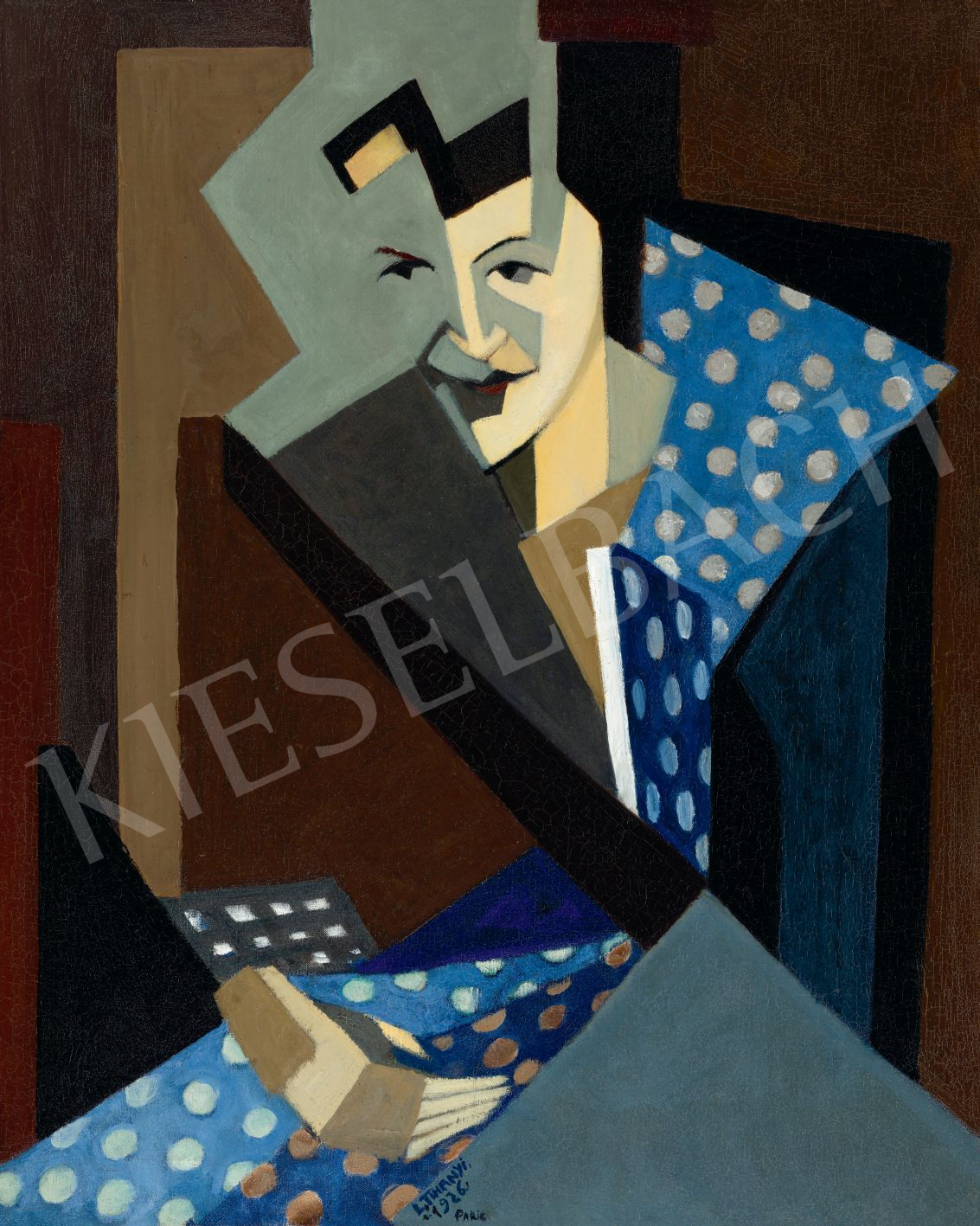
Lajos Tihanyi (1885–1938): Portrait of Tita I (Portrait of Tita st[udium].; La femme espagnole; Seated woman), 1926
81 × 65 cm
Oil on canvas
Signad lower left: L. TIHANYI, 1926 PARIS
Inscriptions on the reverse, painted on the stretcher: "TIHANYI" and a fragment of a label from the Lefranc artists' supply company in Paris. Autograph inscription on the back of the canvas: "TITA".
Appears as number 39, titled Portrait of Tita st., in Lajos Tihanyi's autograph oeuvre-catalogue.
Provenance: In the possession of Ariel and Will Durant (New York) from 1929.
Presumed Exhibitions: Showing of European and American Moderns, Murai Galleries of Contemporary Art, 47 West 52nd Street, New York, February 5–22, 1930 (item no. 32, Seated woman).
Lost & Found
Lajos Tihanyi's life's work is among the most thoroughly examined, well-processed, and deeply researched oeuvres by art historians. No other member of the "The Eight" (Nyolcak) group has had as many studies, monographs, or exhibitions dedicated to them as he has. Thus, it is particularly strange that this newly emerged masterpiece was never reproduced in the professional literature. Given that a contemporary black-and-white archive photograph of the work has been available in the Hungarian National Gallery (MNG) archives since the early 1970s, it is even more peculiar that no attention was paid to the fact—even in connection with the recent Tihanyi 140 exhibition—that the painting Spanish Woman, which was displayed there, once had this companion piece.
Furthermore, this is an earlier work that records the primary artistic invention more faithfully; it is a more complex and detailed piece: the one now going under the hammer. The archive photo of the painting likely misled previous researchers. They overlooked it because a photograph was also taken in the 1930s of the work's companion piece—a larger but less detailed version—which entered the museum's archive half a century ago with the painter’s estate. It appears they thought these two photos were not of two different paintings, but of the same work.
However, it wasn't just this photo that proved Tihanyi painted two pictures titled Tita. A few years before his death, the artist compiled an inventory of his works, reflecting on nearly three decades of his career. In this list containing hundreds of paintings, the two works appear consecutively as numbers 39 and 40, though the creator was off by one year in his dating. One—the work that has now surfaced—is titled Portrait of Tita st., while the other, known today as Spanish Woman and held by the MNG, is listed as Portrait of Tita large (sic!) in the autograph oeuvre-catalogue.
One could have suspected from this that beside the known work, there must be another version that prepared it. In the most comprehensive two-volume monograph of the painter's work, Tihanyi's item 39 is listed in the inventory, but the author did not link it to the photograph in the archives and merely noted that it was "missing". A line below, however, the title "Portrait of Tita" is listed among the title variants of another item. That painting also ended up in the MNG, and an autograph inscription on its back reads: "Dorothy 1926 Tihanyi". Valéria Vanília Majoros linked this painting with item 40 of Tihanyi’s own inventory, which is clearly an error, as item 40 is identical to our companion piece that came from the estate to the MNG, the aforementioned Spanish Woman. Majoros also fails to mention that the latter work appears in Tihanyi’s list, which is another mistake.
While the model in the painting inscribed "Dorothy" does somewhat resemble Tita—Tihanyi's Spanish girlfriend met in Paris, who is the subject of both the newly surfaced painting and its MNG counterpart—we currently know of no decisive evidence regarding this. In other words: whether Dorothy is identical to Tita is not yet clear. By incorrectly evaluating the sources, a great deal of confusion was created, making it very difficult today to untangle what refers to what in this sea of data.
In any case, on the back of our subject painting—to aid later identification—Tihanyi wrote his lover and model’s name in thick, wide, large majuscules: "TITA". Therefore, this newly emerged painting—considering other data described below—is clearly identifiable as item 39 on Tihanyi's list, while the reduced version kept in the MNG (Spanish Woman) can be taken as identical to item 40.
I myself did not notice that Tihanyi painted this portrait composition on two separate occasions while browsing the public collection's archives, but a few years ago in Paris, while researching the materials of the famous French art photographer Marc Vaux in the Centre Pompidou library. There I realized that these were actually two very similar works, not just one. Based on the black-and-white photos, the difference between the two paintings is not so striking to a superficial viewer, but I noticed then that in one version—the painting that has now surfaced—the model's hand is visible, while in the other piece in the public collection, the painter had already eliminated it.
A few weeks before the close of the last Tihanyi exhibition, I started a blog series on Lajos Tihanyi’s missing works with the intention of helping as many of these lost pieces surface as possible. I published the "WANTED picture" now going to auction right at the beginning, in my third post. I expected it to surface sooner rather than later, as during my investigations I had reached the descendants of the former owner. The painting was no longer in the family's possession, so I was surprised that in the weeks following my post, I could already see it in color and in the original. The emergence of this masterpiece is a true sensation and a celebration, as on the 100th anniversary of the painting, another significant puzzle piece has been added to Tihanyi's increasingly reconstructible and exceptional life's work.
The Distinguishing Hand, or Tihanyi's "Doublings"
"I give everything its value in one setting: picture = object, behind which the soul does not lurk but is present."
As the present example proves, thanks to the driving force of the art trade, more and more Tihanyi works—previously thought lost or even completely unknown—have reached the desks of art historians. As a result of the research uncovering the history of these paintings and other parallel background research, a previously undiscussed, characteristic painterly method of the artist is becoming more clearly outlined. More and more recently discovered examples show that Tihanyi systematically made duplicates of certain works throughout his career, and in some cases, he painted the given composition not just in two, but even more versions. Studio copies do occur, but in the vast majority of cases, we are talking about reinterpretations and versions showing various changes rather than mere copies.
Among his favorite subjects, his landscapes, we can find many examples where the landscape elements are identical, but changes in perspective prove they were painted at different times, always on location in nature, en plein air, rather than being so-called studio copies. However, there is an example of the opposite. Perhaps the most famous are his two strikingly similar Parisian cityscapes titled Pont Saint-Michel, which set individual auction records a few years ago. Besides the complete compositional agreement, even the number and positions of the staffage figures, passers-by, and booksellers are nearly identical in the two pictures, suggesting that in this case, the copying took place in the studio. Even here, we do not encounter a slavish copy; rather, reduction and simplification were likely the goals in creating the second version.
We also know of series made of the same motif—for example, among his vedute painted during a summer spent in Szécsénykovácsi—where not only do two very similar oil versions exist, but also a preceding watercolor study. In the case of landscape duplicates, versions made with minor or major shifts in position are much more common, such as his landscape series capturing forest paths painted during the "The Eight" period. Later, during World War I, Tihanyi painted several very similar works in the Balaton Uplands, and the protagonist of these pictures is usually the characteristic monadnock, Gulács, painted from different perspectives. A very similar version of his 1915 landscape Stony Landscape, kept in the MNG and painted in the same area, surfaced at a foreign auction a few years ago. It is clear here too that the near-identity of the view is not the result of copying. It can be clearly deduced that Tihanyi recorded the same landscape detail on two occasions at the same location, but on the second occasion, he set up his portable easel slightly further away.
The same happened with the recently auctioned painting Margaret Bridge. Here, too, we are not dealing with a copy made in the studio, but with works painted in "two sittings" from two slightly different positions and very similar but not identical viewpoints. In his final years, loosening the rigor of his abstract period and returning somewhat to figurality, Tihanyi painted several very similar landscapes of the same view in Toulon, following a method similar to the previous one.
Doublings occur in large numbers throughout the Tihanyi oeuvre in other themes as well: there are examples among nudes and nude compositions, but we also know of still lifes and several portraits—similar to our subject work—that were made in two or even more very similar versions. Among the portraits, cases are known where the difference is almost nuanced, with perhaps only the background color changing while the shaping of the face remains almost the same; in such cases, we can speak of a copy. With still lifes—as with some landscapes—the newer variant was clearly born with the intention of simplification and reduction. Flirting with abstraction, he also painted strikingly similar works on numerous occasions, perhaps involving some formal or color changes. When doubling non-figurative compositions, his imagination was clearly excited by the exploration of possibilities inherent in variations and experimentation.
Dozens of examples thus prove that "doubling" was indeed part of Tihanyi's working method. But what justified painting similar versions? There is no single answer valid for every pair of pictures, as a different reason lies behind each case. It sometimes happened that he was dissatisfied with a composition in progress and cut up the canvas. This is how his painting Boy in a Red Shirt was born, along with Boy with a Cap from another fragment of the original work (see also in the current auction's offering); he then repainted the entire triple composition on another, slightly larger canvas. We know this more representative version as Worker Family.
In other cases, the reason can be traced back to the fact that Tihanyi was known to be attached to his own paintings; he found it very difficult to part with them even when offered a high price. If he did give in, duplicates could be made that we can evaluate more as copies; a similar situation existed regarding some of his landscapes, where a successful sale justified the creation of a second or even third version. In most cases, however, painterly experimentation was clearly the driving force.
Regarding our subject work, there is no known clear reason why a second version was made. The most likely suggestion is that—despite the identical dating—Tihanyi perhaps did not paint the "copy" immediately after the first work, but years later due to its sale. But it is also possible that he simply continued to experiment with simplifying the composition. Whether this reduction process was a truly successful venture on his part is another question.
In any case, it is certain that the painting that has now surfaced was completed first. This is indicated by the artist’s autograph oeuvre-catalogue and also by the fact that this "study"—which can retrospectively be considered a prototype and is named as such in its title—is more detailed and fresher, crispier, and more inventive in its painterly solutions. The larger painting that came from the estate to the MNG is flatter, more sterile, and somewhat more boring; it bears the mechanical emptiness resulting from copying, although he did sneak in a new color, a dull, tired purple, into the new version. He also varied the rendering of the face with new colors, but this did not benefit the larger version either, just as the woman’s gaze lost its suggestiveness in the copy.
The composition of this recently emerged painting is made much more unified and "understandable" by a detail that Tihanyi inexplicably omitted from his other work. The plastic depiction of the woman’s softly bent hand pulls the composition together and makes it compact. Thus, the figure's outlines and spatiality are much more clearly perceptible, and the strictly flattened picture surface also becomes more playful and enjoyable. Just as the outfits of Parisian women are generally made exciting by small, clever accessoires, this hand motif makes the composition more elegant and complete. It is a pity that Tihanyi gave up this necessary element in the second version, which contains mostly copied details.
The drape and spatiality of the woman’s polka-dot dress are also much more perceptible in this first version. Here, Tihanyi does not just use different shades of the blue base to suggest parts falling into shadow, but he also tunes the color of the spots to the lighting conditions. Overall, a modern chiaroscuro effect prevails in the first piece, while the flat effect clearly dominates the second version. The "handed" version also faithfully preserves Tihanyi’s original brushstrokes on its surface, as it emerged in perfectly intact condition after a hundred years of being missing. The appearance of our painting is thus joyful simply because it can be studied in this untouched state, making Tihanyi’s methods of image construction much more perceptible. Just as he breaks up the flat surfaces here and there with effects indicating spatiality, a certain plastic playfulness can also be observed in the elaboration of the picture surface. For example, he dynamizes the more smoothly applied homogeneous surface units—such as in certain fields of the dress—with thicker, more oily, and "popped" spots.
Tihanyi and Photography
"Daumier is not my ancestor, George Grosz (the satirists) is not my companion, but my spiritual and material ancestor is: Daguerre; and my contemporaries: Photo Manuel, Photo Roseman, and all good photographers, albeit without all principles and elements of construction, in the construction of nature = spirit and matter."
Tihanyi's life's work was interwoven with his multifaceted relationship to photography. During the art historical background research for our subject painting, this connection surfaced in many layers of the investigation. His peculiar attraction to it might be attributed to the fact that his father—upon learning of his son's incurable deafness and muteness—intended a middle-class profession for him where verbal communication was not a primary requirement. Thus, before his final career choice, he spent some time as a photographer's apprentice. Although he soon grew tired of continuous retouching, photography continued to play an important role in his life.
The aforementioned Marc Vaux art photo, besides making the existence of a previously unknown version clear, helped us compare the condition of the now-surfaced picture with its state from a hundred years ago. The intact condition of the work was revealed by comparing it with Vaux's razor-sharp photograph, which faithfully renders every tiny detail of the painting's surface and the traces of brushstrokes—the plasticity of the surface.
Tihanyi differed from most of his colleagues in that he regularly had photographs taken of his works throughout almost his entire career, so a very large amount of archive art photography material is available to researchers. Many well-known photographers took shots of Tihanyi’s paintings, even those for whom this was not their main profile, but who became owners of the artist's works either through purchase or as compensation for their work. In the first, Hungarian phase of his career, he mostly turned to Aladár Székely and Dénes Rónai, but the Gárdonyi brothers' photography studio on Dohány Street should also be mentioned. In his Berlin period, high-quality photographs were taken of almost all his important paintings, and he even had his more significant graphic works photographed. In Paris, besides Photo Herdeg, he used the services of a photographic agency, S. Londynski Agence Photographic, for the wide distribution of his works, but the backs of most photographs from the Parisian period bear the stamp of Marc Vaux's photo salon.
It is clear from his extensive, rich correspondence that Tihanyi tried to gain as much recognition as possible with the help of these photographs; they were important tools for his self-management, which finally took shape in the form of a representative album in 1936, two years before his death. In the volume, published with a preface by the French surrealist poet Robert Desnos, he showed works from his career only up to 1922, perhaps with some caution to satisfy the taste of more conservative buyers. At the same time, it is possible that a second volume would have been prepared of his more modern, latest works using mostly existing clichés.
In many cases—as with this picture—these archive art photographs aid our work. Even today, we know of about three dozen Tihanyi paintings exclusively from these black-and-white photographs, but hopefully, the number of "WANTED" works will decrease precisely thanks to the success of such reappearances.
Besides the already mentioned Hungarian photographers Székely and Rónai, two other photographers of Hungarian origin who later gained world fame were part of his closest circle of friends in Paris. He knew Brassaï from Berlin, who at that time was still trying to establish himself as a painter under the name Gyula Halász. Comparing Brassaï's paintings—still signed "Halász"—with Tihanyi's style of the time, it is clear that the most expressive artist of "The Eight" had a huge influence on his friend from Brassó. The same can be said of André Kertész, who arrived in Paris the year before the Portrait of Tita was painted.
Kertész considered Tihanyi his best friend in Paris because Tihanyi showed him the hidden face of the French capital, introducing him not only to well-known sights but also to the hidden corners of Montparnasse, artists' haunts, and the hangouts of painters who had gathered there from all over the world. Kertész accompanied his painter friend everywhere—to his second home, the Café du Dôme, to exhibitions, to art dealers, to Hungarian and French painter and sculptor acquaintances, poets, and friends. Thus, a significant part of the photographer's expanding network of connections in France was thanks to Tihanyi. Documenting their continuous time together, Kertész took entire series of photos of Tihanyi. The memory of this close relationship is preserved not only by so-called situational photographs but also by excellent portrait photos; he even took some art photographs of the artist's paintings.
Tihanyi's works also influenced Kertész. One need only think of the famous pair of images: the painter's purist Still Life with Pipe and the similarly arranged photo composition that the photographer captured in Piet Mondrian's studio. At the same time, it is almost impossible to imagine that Tihanyi's nude compositions with distorted anatomy did not provide the main inspiration for Kertész's Distortions series and album, which established his later world fame.
Tihanyi's Mysterious Tita
"There was my friend Tihanyi, the deaf-mute Hungarian painter whom every girl loved." - Oskar Kokoschka
André Kertész also photographed the model of our painting, Tihanyi's current love, Tita, in the painter's company, in a moment that reveals much about their relationship. The woman receives Tihanyi's advances somewhat recoiling, but her lips are curled in a sincere smile, and love sits in the meeting of their clear gazes. Whether the Spanish lady's heart also burned with love or whether only Tihanyi flamed for her is unknown; in her eyes, one sees rather the friendly love felt for the kind, eccentric Tihanyi.
We know little about Tita; her full name had not been revealed by the literature before, although her address appears in two of Tihanyi's notebooks. In one, he recorded it under "Bauer Tita," and in the other under "Bauer Tita Avilés". The original name in proper form could thus have been Tita Bauer Avilés. Every known source mentions her as Spanish, yet she did not speak to Tihanyi in French in Paris (which would have been more logical, as it belongs to the Latin language family), but communicated in German. Her German-sounding surname may explain this, as her father was presumably German (speaking).
The circumstances of their meeting are lost in obscurity, but Tita likely did not reside in Paris permanently. At the same time, Tihanyi recorded two of her Parisian addresses: one was the Martha Pension that once operated at 97 rue Lauriston, and the later one was not far from there, at 164 Avenue de Malakoff. These two addresses, a few streets from the Arc de Triomphe in Paris's most elegant 16th arrondissement, suggest that the elegant Spanish lady may have lived in comfort.
In letters written to his friends, Tihanyi reported on the great love, but little further information can be gained from these dropped sentences. He confided most in Brassaï about the story of his romantic struggles, who was in a similar situation at the time. Their correspondence reveals that this liaison—which perhaps never truly reached fulfillment—could have lasted only half a year, and the painter likely met Tita in Paris sometime at the end of the summer of 1926. The portrait of her was painted at this time.
The Spanish lady traveled to Nice with her family or friends in early 1927. She likely sent Tihanyi the beautiful, slightly melancholic photograph of herself then, which came from the painter’s estate to the MNG Archives, now known as the Central European Research Institute for Art History (KEMKI). They also keep a previously unpublished, undated, typewritten letter in German signed by Tita, which she almost certainly sent to Tihanyi not long before her trip to Nice:
"Tuesday
Dear Tihanyi,
This morning I received your letter, and I found yesterday’s as well when I got home. I am very sorry for what happened, but as I told you yesterday, my friends came for me, so you did not find me. I don’t know why you might have thought I was here. I already owe you an answer to several of your letters, but really, I was in such a bad state that you cannot be angry with me for not writing until now. When I was in bed, I could not receive your visit; it really was not a pleasant or suitable illness to receive anyone. I hoped that I would soon be mobile again and we could meet on Montparnasse. Now I am better, and I solemnly assure you that I will not leave without us meeting first. Dora may have told you that I am only leaving on the weekend, so as soon as I am well enough to be away from home for a longer period, I will notify you. Please do not be angry, have a little patience.
Cordial greetings: Tita"
Tihanyi, to clarify the relationship developing between them, followed the dreamy-eyed girl in the last week of January. In his first letter from Nice, he wrote to his young friend, Brassaï: "You cannot believe how delicate Tita is. [...] I saw her already on the second day; I did not come in vain. I have much more affection for her already, and she deserves all confidence. I don’t know where this Spanish girl took on this peerless elegance; I have never seen a woman so able to command herself and deal with others. (Don't think it’s bias born of love.) Tita is sad. God knows what’s bothering her. They live very well, in a very beautiful apartment. I am a guest every evening because I want to be with her. [...] I am really as well as if the Good Lord had favored me a little. I won't even try to be luckier in love: the friendship of a truly pure, good woman is certain until now."
The second letter has a more resigned tone: "My first letter overflowed with happiness. It would be better and nicer if you waited in this belief. Terrible misfortune pursues me on this otherwise beautiful journey. Tita and I sit wordlessly for hours. She didn't want to say a word to anyone. Yet she is the only one from whom I get wise words and guidance. And a zest for life. I am well, only as you can see, whether I want to or not—I suffer. Perhaps one day you will learn the true story of this six-month affair of mine, which despite all hopelessness gave me incredible zest for life and provided much joy, which, maybe, will equal the pains. There is no room to write about this now. But it is sad that the word is choked within me."
In his last letter from Nice, the end of the relationship is outlined: "I couldn't have expected a better, only a nicer conclusion. But now it doesn't matter. Don't fear for my peace; I will never be peaceful as long as I truly live. I hate that. But of course, this is a different restlessness: a stimulating one that gives life to me and my works. It is very much to be feared that I will lose her, but I don't want to believe it. At home, you will get a clear picture of this matter. Tita is a strange woman. She has much wonderful strength of soul and delicacy in her that deserves respect, but she is a woman—not a logical mind. I am quite logical even in love, but I only see this late in my actions—now too. This already gives some peace. If only such peace wouldn't dry up my brain."
In a letter addressed to his lawyer friend in Nagyvárad, Dr. Virgil Ciaclan, he speaks more in a voice of bitterness: "I am aging, for there is no remedy against time. But neither externally nor in freshness am I behind even young people, and I confess to you, I am so in love that compared to that, you consoled a cold-blooded old man in his spiritual troubles in your pleasure-den on Rudolf Square. But the whole thing is a hopeless, deep affair. Besides that, I am very sad now; one shouldn't come back from Nice, from the Riviera, at this time after a short 10 days. It was nice and warm and so colorful there. (She was there too and unfortunately is still there.)"
From all this, it appears that Tita remained on the Azure Coast, and after that, she is no longer mentioned in the known letters. Their mysterious relationship is immortalized by the painting now waiting for a lucky new owner, as well as by André Kertész's photograph, capturing Tita in the very polka-dot dress in which she posed for Tihanyi.
In the corner of the photo, behind the Spanish woman's back, an oval-format portrait photo is visible, which regularly pops up in photographs of the painter’s studios from Budapest to Berlin, usually in prominent places, most often on his desk. Here, in Paris, he placed the photograph of this person, so important to him, directly next to his bed. This portrait photo, which he took with him everywhere during his moves, preserves the memory of an earlier, similarly hopeless love: Gitta Lázár was a married woman, the wife of Jenő Lázár, a journalist, and a beauty admired by many. Tihanyi also painted a portrait of her in the Austrian capital when Jenő Lázár was the editor-in-chief of the Bécsi Magyar Újság. The painting is lost; we only know its archive photograph. That Tihanyi was in love with Lázár’s wife was commemorated by, among others, Edith Gyömrői—a psychoanalyst, poet, translator, writer, set and costume designer, and photographer. At the beginning of the Viennese emigration—since Tihanyi's apartment was very cramped—he deposited his paintings brought from Budapest in Gyömrői's spacious studio-apartment, which she had on loan, and showed his works to his friends and acquaintances there. The first person he took to Gyömrői's apartment for this purpose was Gitta Lázár. Gyömrői wrote of the visitor: "Gitta Lázár was a beautiful young woman, and I felt that she was so enviably aware of her beauty that this beauty radiated from her multiplied. It was as if the sun were shining from her onto Lajos Tihanyi."
It is strange that this single André Kertész photo preserves the memory of two hopeless loves at once. But while on the subject of memories, Tihanyi also commemorated his meeting with Tita in Nice in another work, but this is not a portrait, but a landscape, which he likely painted not on location, but after returning to his Parisian studio, from memory and presumably based on a graphic sketch made in Nice, possibly using a photo. This exceptionally atmospheric landscape was given two titles by its painter, both referring to remembrance: Souvenir de Nice, i.e., Memory of Nice, and Souvenir du midi, i.e., Southern Memory. We know this excellent cubistic painting only from Marc Vaux’s black-and-white archive photograph, which has been preserved in two copies in the Tihanyi estate, and the two different titles can be read on their backs. The work, like the Portrait of Tita, also went to an American owner in New York, but its current whereabouts are unknown; it is missing.
Return to Paris – Final Settlement
At the time the Portrait of Tita was painted, Tihanyi had already been breathing the fresh air of Paris again for years. Although he had created outstanding works of his life's work in Berlin in the early 1920s, he did not feel truly at home in the German capital. In contrast, at the turn of 1907–08, when he first visited Paris as a novice painter, he was spellbound by the City of Light. Under the influence of the French Fauves, primarily Henri Matisse and Albert Marquet, he immediately created works that would hold their own in any exhibition showcasing Fauvism—and all this when he had first picked up a brush barely two years earlier. At that time, he painted the Pont Saint-Michel and its surroundings from the hotel room he rented there, a place he had longed for ever since.
When he returned to France in the autumn of 1923, he took possession of the city again with bursting joy and immeasurable delight: "My old love blooms again, even better than ever. Paris is magnificent, bright, rich; the French are kind, and the women are so beautiful—it's just that they weren't waiting for me. You can imagine how good it is to be here. After Berlin, which is the shadow of this light," he wrote enthusiastically to his old friend, Virgil Ciaclan. For a short time, to wind up his life there and take his beloved artworks with him, he returned to Berlin, but he already spent Christmas 1924 in Paris again. From then on—aside from a short American detour—he remained there for the rest of his life, but his final settlement met with many obstacles.
It took years before he could finally exchange his cramped hotel room for a studio. He moved into the studio rented on rue de la Glacière at the end of the summer of 1925, opposite the metro station named after the street. The view from the studio soon inspired an entire series of constructive-spirited pictures, primarily his Metro series. As he had previously in Berlin, he tried to gain exhibition opportunities in Paris. He came into contact with the most important gallerists of the period; his notebooks contain names like Daniel-Henry Kahnweiler, the Rosenberg brothers, Léopold Zborowski, and even József Brummer—who had emigrated from Szeged and later became the most influential gallerist in New York—and his first Parisian secretary, Dezső Kellermann.
However, Tihanyi was a difficult personality; he didn't even know the flexibility required for self-promotion. After his friend's death, Brassaï wrote of this: "Tihanyi was a distrustful, stubborn, ungovernable nature; moreover, his physical disability was also a disadvantage, but he did not have the slightest flexibility in him, which the world demands for success. He worked out his pictures slowly and pampered them like his own children; he was terrified even at the thought of having to part with any of them, and he resorted to cunning to discourage his buyers. He even rejected the contract offered to him by Zborowski, the art dealer of Modigliani and Soutine."
Tihanyi's self-destructive resistance led to the fact that he was unable to conclude an agreement with any gallerist that suited him, as he actually did not want to sell, only to appear, to get exhibition opportunities. Naturally, profit-oriented dealers could not take this seriously. Thus, despite a lot of invested energy, there was only one occasion in the remainder of his life where he could present himself independently, free from the pressure to sell. In 1925, his already mentioned old acquaintance, Edith Gyömrői, had a Polish friend who had just opened a music shop, Au Sacre Du Printemps. On the occasion of the opening ceremony, Tihanyi was able to appear before the Parisian public independently for the first and last time; thereafter, he only presented his latest works in group exhibitions.
In the same year, in the still unpublished revision of Ernő Kállai’s New Hungarian Painting—now an indispensable fundamental work—mention was also made of the difficulties of Tihanyi's arrival in Paris and the reasons for his initial "improductivity". The rich text preserved in a typed manuscript, previously completely ignored and unexploited by Tihanyi researchers, only partially reflects on Kállai’s chapter dealing with him; rather, the painter’s current painterly theories seem to be outlined in it, also explaining why he did not try to humbly meet dealer expectations and why he did not churn out works by the dozen. Tihanyi’s raw humor, not devoid of self-irony, also sparkles in the opening lines: "Because of the aesthetic corpse-mongers and catalog-makers, two of my Parisian years were lost. Not a single fireplace corner, not a single chimney arching gothically into cubism, or a deformed guitar decorated with hussar-braiding can be recorded in the recent past of my art. Withering and fresh bananas also only gave me digestive emotions. And as for the bottles of Bordeaux and Burgundy, I did not break them down into planes if I was lucky enough to come into contact with them."
Rediscovered Cubism
In his 1925 writing quoted above, it was no coincidence that Tihanyi—even if jokingly—evoked the formal culture of Cubism, as his stylistic orientation at the time was indeed pointing in this direction. In the following year, he actually painted several subjects from those he had proposed, already partially showing the formal characteristics of Cubism. It was as if he had predicted his Metro series, dotted with a forest of slender chimneys, or his two similar versions of Bouteille, Cubist still lifes painted of wine bottles. Yet he was only joking with them then.
The new studio certainly contributed to his reactivation, but other sources of inspiration are also worth looking for in the background. It is obvious that the precursors of the change in direction are already perceptible at the end of his Berlin period, as parallel to the reduction of his palette, his pithy compositions also simplified and became increasingly geometric and constructive. Such are his already mentioned Still Life with Pipe and his painting Bridge, which are actually logical continuations of the newer pictures, which already show clear local, French influence.
In Paris, Tihanyi was confronted with radical manifestations of new painterly tendencies, involving reduction not just of colors and forms. In the avant-garde circles of the French capital, the spirit of Purism was conquering at the time, largely under the influence of the two defining personalities of the journal L’Esprit Nouveau, Amédée Ozenfant and Charles-Édouard Jeanneret, i.e., Le Corbusier. Tihanyi was a subscriber to the magazine, but he did not only get information from there; he also gained fresh impressions from their exhibitions, and Ozenfant even visited him in his studio, so he met him personally.
Tihanyi was considered an expressionist-oriented artist at the time, which he resolutely protested against. Ernő Kállai also rather categorized him with the expressionists, but he claimed no kinship even with the greats acknowledged by Kállai, Chagall and Franz Marc: "Even compared to these, my works are quite unprecedented. Especially if—as Kállai correctly does—one only examines and analyzes the painterly values and spiritual references of Cubism." Knowing his earlier pictures, however, his expressionist mode of expression is undeniable, while Purism and Cubism eliminated emotions. Thus, taking up this standpoint diametrically opposed to his earlier view, a radical change occurred in his painting, involving fundamentally different painterly manifestations.
As a sovereign artist, of course, he did not adopt Purism and Cubism in their pure forms either; he tried to get to know the formal world of other modern movements as well. The large-scale exhibition L’art d’aujourd’hui, held in November 1925, was the first great international review specifically focusing on non-figurative and abstract movements. The aim of the exhibition was to present trends after Cubism, with particular regard to Constructivism and the De Stijl movement, but the most important figures of late Cubist trends also lined up here, such as Picasso, Robert and Sonia Delaunay, Albert Gleizes, Juan Gris, Fernand Léger, or even the Cubists of Hungarian origin then already considered French, Alfréd Réth and József Csáky. Tihanyi himself participated in this exhibition with a single composition; at this time, he was mostly influenced by his late Cubist contemporaries.
According to available sources, he knew these mostly French artists personally. Seeing his new change of style, however, the greatest icon, Picasso, fell out of Tihanyi's favor, and it was precisely because of him that he took Cubism under his protection. He wrote of this to Ödön Mihályi in May 1924: "Last month there was Picasso with 12 new large neoclassical and unclassically bad kitsches. It is sad to see this clinical picture and to read from Ivan Goll (he wrote it in Kunstblatt) that 'art has finally crawled out of the cubist tunnel and come into the sunlight.' Living among such contemporaries is sad." For Tihanyi in these years, Cubism thus continued to be a valid baseline that opened new doors for artistic development, an origin from which he too could start with renewed strength on the road leading to full abstraction.
Throughout his life, he tried to carefully avoid the appearance of being locked into stylistic categories, repelling any accusation that threatened the absolute independence of his painting; but with Cubism, it seems, he made an exception. So much so that in his autograph oeuvre-catalogue, he wrote "Cubiste" right next to the title of the Portrait of Tita now going to auction! This remark of his could not have been accidental, as he does not indicate any stylistic direction in connection with any other work. There is undoubtedly a well-founded intentionality in his decidedly emphatic remark, added retrospectively to the revised list of works. It is true that there are few paintings in the entire oeuvre endowed with such clear stylistic features as our subject picture; thus, Tihanyi’s exceptional categorization proves absolutely correct. He does exactly as the Cubists do: he abstracts, applies radical color reduction, breaks down into planes, and sets into space. A harmonious dualism of plasticity and planar depiction prevails in the picture, and he even adopts the mask-like depiction characteristic of Cubist painters.
If we compare the work with its epochal analogies, it can be clearly fitted into the line of paintings by the best-known Cubists—the Spanish-born Juan Gris like Picasso, or even the Italian Gino Severini who was also living in Paris at the time, the Polish-born Louis Marcoussis, but most of all Albert Gleizes—works that today mostly decorate the walls of prominent museums. He met Gleizes, the number one theorist of Cubism, a year before the Portrait of Tita was painted. He reported on his visit to him to Ödön Mihályi as follows: "I visited Gleizes recently. G. is a painter of great style [sic!] and an unparalleled kind man. I would make much use of the latter through the surely felt sympathy if I could speak with him. Beside constating the latter, I only see now that Gleizes, who is the true cubist painter, does not even reach with his magnificent material of 12-13 years ago what I was doing at the same time. Embedded in a poor culture, the romantic-aesthetic period then followed for me too, when the war choked me into this stinking atmosphere (aesthetics), although it did not poison me fatally, for I was not and could not be theoretically a cubist, nor an aesthetic. That is why I see today too that I have made a great painting." The painter could have applied his unmasked, biased self-praise to those works of his around 1912–14 that indeed testify to the influence of the heroic age of Cubism. Such is, for example, his Self-Portrait also presented at the 1915 San Francisco World's Fair.
Thus, in 1925–26, Tihanyi did not meet Cubism for the first time, but rather returned to it with a convoluted detour and rediscovered it for himself. This new encounter, however, already involved conscious alignment. It is known from his notebooks and other sources that he entered into contact with those leading Parisian gallerists who specialized mostly in Cubist painters at the time. He visited the gallerist of Picasso, Gris, and Braque, Kahnweiler—who, of course, at that time could not show his own Cubist pictures in large numbers, so cooperation was out of the question. Léonce Rosenberg, the most influential supporter and popularizer of Cubism between the two world wars, was searching for new artists in these years, so Tihanyi's negotiations with him were more promising, but in the end, no agreement or contract was concluded with him either. Two Cubist sculptors, József Csáky and Henri Laurens, belonged to the core group of the Galerie l’Effort Moderne led by Rosenberg; their reduced forms and the solutions of their colored sculptures and reliefs—even if from a distance—can be related to Tihanyi’s Cubist female portrait, and it is almost certain that these artists also influenced him. Their success also provided a good example for the painter; thus, a kind of sober alignment may also have been at work in his turning toward Cubism.
Tihanyi's Purchasing Elite
Since he did not manage to reach an agreement with the gallerists, he still had to maintain himself from something. By this time, the support coming from home, from his family remaining in Budapest, was increasingly dwindling. His brother, Ernő, continued their father's well-running business, the Balaton Café, but from this, Tihanyi got less and less, and in the end, nothing at all, so he was forced to part with some of his works, no matter how much he was reluctant to do so. A picture of the painter has developed in the literature that he was obsessively attached to his works and kept himself away as much as possible from the commercialization of art. In contrast, the sources show a much more nuanced picture, as considering the number of sales, Tihanyi can be considered one of the most successful Hungarian painters.
Despite his communicative handicap, he developed an incredibly wide international circle of buyers over the decades. Of course, we must include those, like the film-making Korda brothers, who regularly bought pictures from him for the purpose of supporting the artist who was on the verge of poverty, but this refers rather to the mid-to-late 1930s. Examining the artist’s autograph oeuvre-catalogue, near 150 (!) titles out of 231 items include the name of a buyer; this means that about two-thirds of the oeuvre did not remain with the painter. In this list compiled from memory in the 1930s, Tihanyi recorded beside the titles of individual works the location and time of painting, as well as when, where, and to whom he sold it. The imposing network of this incredibly representative list of names, spanning national borders and even across the sea, is truly impressive.
His paintings found buyers in Nagybánya at the very beginning of his career, and then later almost throughout the whole country, in Kolozsvár, Arad, Nagyvárad, Debrecen, Békéscsaba, Gyoma, Nagyszőlős, Gyöngyös, and of course in Budapest in large numbers. In the representative list of names of the Hungarian buyer circle—mentioning only the most important ones—one finds figures such as Endre Ady, Dezső Kosztolányi, Frigyes Karinthy and his wife Aranka Böhm, Miksa Fenyő, Tibor Déry, and Ödön Mihályi from the world of literature; from among the critics, Artúr Bárdos, Jenő Miklós, and especially his good friend György Bölöni; the psychoanalyst Dr. Sándor Ferenczi, a direct colleague of Freud, furthermore Dr. István Hollós, psychiatrist, the famous printer Izidor Kner, and even his colleague in the circle of "The Eight", Károly Kernstok, etc. His works also entered domestic public collections during his lifetime, such as the Capital City Gallery and the Museum of Fine Arts, and even the Ministry of Finance.
After the fall of the Republic of Councils, he never returned to his homeland again, so his circle of buyers also became increasingly international. He successfully sold paintings first in Vienna, then in Berlin and other German cities, but in his Berlin period, he also met a Swedish tycoon, Gustav Alfred Ekström, the patron of József Nemes-Lampérth; thus, to this day, his works are missing in large numbers in Stockholm and its surroundings, but at this time, his pictures also reached Cambridge and even Moscow.
Since he spent the largest part of his life in Paris, his widest circle of buyers developed here, although a good portion of them were not French collectors. There were, of course, Hungarians among them, like the already mentioned Korda brothers, who partly took the acquired Tihanyi pictures with them to London and partly to the United States. During his lifetime, he received the honor that the French state also purchased an earlier landscape painted in Florence in 1912, but this has unfortunately been lost or perhaps destroyed since then. Later, but also in Paris, a fellow painter, the wife of the Cubist-Dadaist Francis Picabia, also bought a Balaton landscape from him.
As Brassaï put it, Paris "satisfies the luxury needs of rich Americans," and his friend Tihanyi naturally knew this well, as numerous Americans staying in Paris bought from him in the second half of the 1920s and the early 1930s. Among them, the biggest name is Peggy Guggenheim, the niece of the famous New York museum founder Solomon R. Guggenheim, who took two works from Tihanyi's studio: an early 1917 landscape of poplars in Badacsony, as well as a composition of nearly the same age as our subject painting, presumably also of Cubist spirit, Still Life with Grey Glass. These disappeared without a trace from our radars and are still missing today.
Also in Paris, Tihanyi sold an oil study of Brassaï—presumably in tondo format—painted in 1928 to a certain Herbert Morgan, whose New York collection later received this work, which is not even known from a photo and is still missing today. M. Toscan Bennett, who arrived from Connecticut and was newly remarried to a Hungarian wife, presumably met Tihanyi through the mediation of Mihály Károlyi as a leftist politician, just like Morris Hillquit, the chairman of the American Socialist Party. Both bought from Tihanyi in Paris: Toscan Bennett bought a 1927 male portrait—possibly the portrait made of him (?)—which we do not even know from a photo; the tycoon Hillquit bought his landscape Three Trees painted in Potsdam, and later in America also acquired a new painting from him, a still life with palms, also from his Berlin period. Unfortunately, both works are known only from photos. Also through Károlyi, Tihanyi came into contact in Paris with one of the painter’s most important supporters, John Török, the Hungarian-born Greek Catholic bishop active in New York. Török saw great potential in the painter; he already bought a self-portrait from him in Paris and offered to help him get exhibition opportunities and buyers in New York.
In the Promised Land – Tita is Sold in New York
Tihanyi prepared thoroughly for the long sea voyage already in Paris, and when he arrived in New York at the end of January 1929, several people were already waiting for him. After disembarking, however, he could not answer the questions of the immigration officials, so he was taken into custody and was only released after his friends informed the officials that the deaf-mute artist—who was otherwise mentioned as Austrian in the press—had several portrait commissions to complete in New York. They still had to shell out the $500 bail.
His first meeting would have been with the famous American short story writer Henry Miller, whom he knew from Paris through Brassaï, and he would have met him at Times Square—where he had temporarily moved into a hotel—right after his arrival, but the writer excused himself in a telegram for not being able to greet him. Tihanyi allegedly also painted a portrait of June Miller, Miller’s wife who became famous for her eccentric lifestyle, but we do not know this portrait. Finally, a lady also met in Paris took him under her wing, with whom, according to Krisztina Passuth, he even became involved in a romantic affair. This was Cécile Harpham, who was the wife of one of Károlyi's acquaintances, Fred M. Harpham. Harpham was the vice president of the Goodyear tire company at the time, so they presumably could not have had any particular money problems. His wife purchased several of Tihanyi’s pictures: his 1921 Berlin work Still Life with Oranges, of whose black-and-white reproduction we know, but which is just as missing as his 1907 Nagybánya landscape—not even known from a photo—which Cécile hung on the wall in their summer house in Santa Paula, California. The French-born woman also selected from the painter’s graphic works, but these burned at the framer’s. Tihanyi also painted two almost identical portraits of his sharp-featured, pointed-nosed fan, but these did not enter the Harpham collection.
However, Tihanyi indeed frequently received other portrait orders in America, which ensured his livelihood for a time, albeit modestly. This was greatly aided by the fact that there were also quite a few buyers for his earlier works transported from Paris to New York. The buyers were initially Hungarians who had emigrated to America: among others, his fellow painter Lajos Márk, the world-famous conductor Jenő Ormándy, fellow musician Ivor Kármán—whom he might have known from Berlin through his friend Róbert Berény—furthermore the musicologist Egon Kornstein, the sociologist-politician Oszkár Jászi, who purchased several of his works, and the list could go on.
John Török also kept his word and purchased further works from Tihanyi in America. For example, one of the painter's most enigmatic works, which would deserve a separate study, went to him. This Christ composition, which also hides a self-portrait, was made in Berlin and presumably still lingers somewhere in America today. Török also purchased the 1916 Portrait of Andor Halasi, which he donated to the Brooklyn Museum of Art; with a little luck, a visitor can still catch it on permanent exhibition today.
Thanks to the bishop's promised mediation, Tihanyi also gained exhibition opportunities. In the large-scale international exhibition at the Brooklyn Museum taking place from June to October 1929, Tihanyi was given an entire room among 26 artists. Fifteen of his works are listed in the catalog, but he likely exhibited considerably more. Here he achieved success mainly with his more easily accessible earlier paintings, but his latest, more modern works also found an opportunity for introduction at the beginning of the following year. At the second group exhibition of the Manhattan-based Murai Galleries of Contemporary Art, Tihanyi again was given the most exhibition space, so much so that the report published in the press does not even mention the other 11 exhibiting artists, as if the Hungarian artist had introduced himself in a "one man show". In the gallery specialized in contemporary art, they naturally selected from the production of the 1920s, and the catalog contains the titles of about a dozen of his works.
The literature makes no mention of a much more modest exhibition where Tihanyi introduced himself with two other artists: the Japanese sculptor Isamu Noguchi, whom he met in Paris—who at that time also exhibited his bust made of Tihanyi—and the architect Buckminster Fuller, the inventor of the futuristic Dymaxion House. This peculiar mini-exhibition, lasting barely ten days, also opened in Manhattan, in the Greenwich Village district, in Romany Marie’s far-famed bohemian restaurant three days after the notorious stock market crash of "Black Thursday" that caused the Great Depression.
Although the Portrait of Tita appears in the lists of Tihanyi's works shipped to America, it cannot be stated with certainty that it was presented at any of his New York exhibitions; it is probable, however, that this work was featured under the title Seated woman in the exhibition held at the Murai Gallery. However, the portrait likely found a buyer even earlier through friendly mediation. György Bölöni’s wife, Itóka, was at one time Anatole France’s secretary in Paris and thus met one of the French literary giant’s American researchers, the historian-philosopher Dr. Will Durant. She almost certainly drew Durant’s attention to the Hungarian painter. In the remark written by Tihanyi next to the painting's title, it appears that he sold it in New York in 1929 and the owner is "Mme Will Durant". It is possible that the painter indeed agreed on the terms of the purchase with the wife, Ariel Durant, who is also regarded as a famous writer in American cultural history. For long decades, the couple was considered a virtual legend in America, mostly because of their partly co-authored work, the eleven-volume The Story of Civilization, which also brought them a Pulitzer Prize. Little is known about the Durant couple's artistic taste; their collection is not mentioned in sources either, yet they selected from Tihanyi with the best instinct, for besides the Portrait of Tita, they also purchased his much-mentioned Berlin painting Bridge, which after a long period of being missing was sold at the Grisebach auction house in Berlin and then appeared on the cover and poster of the 2012 Tihanyi oeuvre exhibition catalog organized by Krisztina Passuth.
The other memory related to Tita, Tihanyi's already mentioned 1927 painting Souvenir de Nice, was also sold at this time. A certain Eugene Schoen was the buyer, who initially active as an architect—for example, designing several bank buildings in New York—but after the Exposition des Arts Décoratifs et Industriels Modernes exhibition, which he viewed in Paris in 1925, he switched to industrial design and interior architecture. Later he opened a gallery in New York, where among others Isamo Noguchi exhibited. Tihanyi perhaps already met the later gallerist in Paris through the Japanese sculptor. Where Tihanyi’s Nice landscape went from Eugene Schoen’s collection is still a question, but the miraculous reappearance of the Tita picture will hopefully attract the emergence of this exceptional landscape in the near future.
The Place of the Portrait of Tita
With the emergence of every important work, we actually "recalibrate" the artist. The surprise appearance of the Portrait of Tita has raised a series of previously unclarified questions, and through it, several new, previously unpublished sources have come to light. In evaluating this painting art historically, it is worth examining not only its place within his own oeuvre, nor merely its position in the historical arc of modern Hungarian painting, as based on its quality, it can only be measured by international standards.
Universal works judged as masterpieces even by foreign eyes were born in almost every period of Tihanyi's career; however, it was precisely at this time in Paris, around 1926, that he truly managed to rise to a higher league, becoming through his stylistic alignment an integral part and at the same time a shaper of the artistic movements then taking place in Paris. In this period, unfortunately, his works were born in relatively small numbers, so even within his own life's work, we can place few analogies beside it. This newly emerged masterpiece is perhaps most comparable to the significance of the Portrait of Tristan Tzara. It stands out high from the line of other Hungarian paintings born in the period; it is no coincidence that the MNG companion piece of the Portrait of Tita was placed on the back of the catalog cover of a recent exhibition in Poland.
Tihanyi generally, but especially from the period spent in emigration, can no longer be purely discussed within the history of Hungarian painting, as his performance elevates him into the line of those Hungarian-born painters who became significant artists outside their homeland and gained a name for themselves abroad, like László Moholy-Nagy, József Csáky, or Alfréd Réth; but beyond this, this picture is much more comparable to works painted at this time by the great figures of international movements, Metzinger or even Gleizes. Tihanyi’s painting in the twenties has almost nothing to do with his Hungarian roots; it would be absolutely fittable internationally even into the line of French artistic manifestations and would hold its own anywhere, even in the world's leading museums.
He himself knew that he had almost no connection to the fabric of Hungarian painting there and then. In his review of Kállai’s book, he wrote of this: "Kállai ties, pastes, and glues everyone to the Hungarian soil. [...] I, on the contrary, was waiting for something quite different; not chains or rope that bind to the Hungarian soil, or even to the whole today's u.n. culture. Not this chemically fabricated, gummed adhesive, / rather the separator/ [...]" It is a great pity that Tihanyi did not find such supporters and patrons for his rise to international level as his more fortunate French peers; thus, he often had to go without, even lacking money for canvas, since a ready-primed painter's canvas stretched on a frame was an expensive luxury in Paris.
The raw material of the now-surfaced picture, however, is first-class; he purchased it from one of the most prestigious artist supply companies that is still prosperous today, as proven by the label fragment remaining on the stretcher. "You could see with me that canvas I bought; it hasn't left me in peace for a week now"—he wrote to his pal Bölöni precisely at the time when he immortalized Tita. Who knows? Perhaps it is precisely in this empty canvas that once excited Tihanyi that we can now delight as a masterpiece, and finally in person!
Gergely Barki










 Facebook
 Instagram
 Pinterest
 Youtube