|
|
|
|
|
|
|
|
|
|
|
|
|
|
|
|
H-1055 Budapest
Szent István körút 5.
| Phone: | 00-36-1-269-3148 |
| | 00-36-1-269-3149 |
| Fax: | 00-36-1-269-2219 |
gallery@kieselbach.hu
|
|
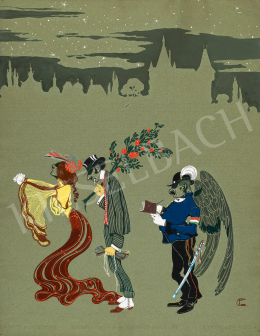
Bortnyik, Sándor (1893 - 1976)
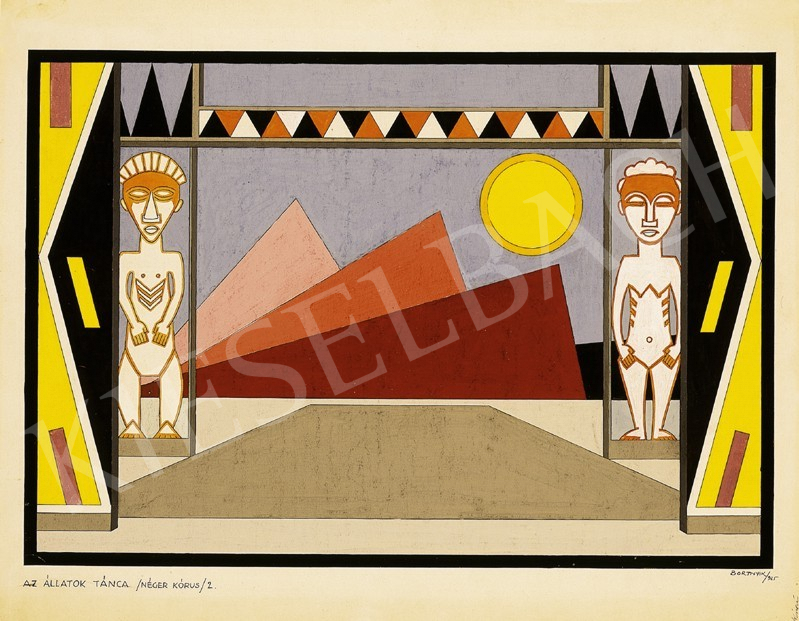
Bauhaus- composition, 1925
35x51 cm mixed media on paper signed lower right: Bortnyik 925.
Exhibited:
Károly László Collection. Palace of Art, Budapest, 1996.
From 1922 to 1924 Bortnyik spent two years in Weimar, that was one of the centers of Bauhaus. His paintings made at that time are highly evaluated both by collectors and art historians. His pictures painted in the spirit of Constructivism can be found in such famous collections like that of Thyssen-Bornemissza or Emilio Bertonati. Bortnyik's Bauhaus-pictures rose to notice at the end of the 1960s. Five of his paintings were exhibited at the exhibition Avantgarde Osteropa in Berlin, but his real breakthrough was the exhibition Osteuropäische Avantgarde in 1970 in Köln. Since that time his early pictures has been regularly presented not only at national avantgarde exhibitions but also at different auctions overseas. Although the picture under discussion was painted in 1925, with regard to its style it belongs to Bortnyik's Bauhaus period.
Bortnyik studied under Kernstok, Rippl-Rónai and Vaszary. He became a friend of Mattis-Teutsch's, who introduced the young painter to Lajos Kassák. From 1917 Kassák frequently published Bortnyik's pictures in his avantgarde magazine, MA (Today). After the fall of the Hungarian Soviet Republic Bortnyik followed Kassák and his circle to Vienna, where he began to create his geometric abstract compositions. In 1922, after a theoretical debate with Kassák, he left Vienna and moved to Weimar. He held an extremely successful exhibition in the most famous avantgarde gallery of Berlin, in the Sturm. What was special about this exhibition was that all of his pictures were sold to a Swedish collector.
Bortnyik was enchanted by the spirit of Bauhaus that advocated the unity of architecture, painting, sculpture and applied arts, but he never became a real member of the circle. He also met one of the leading artists of the group De Stijl, Theo van Doesburg. In Weimar his style gradually changed. His compositions became more and more plastic, the role of three dimensional space got more important. In 1924 human figures appeared in his geometric space constructions. The picture under discussion belongs to this series of the artistic development. The defining element of the stagelike composition is the grey plate which is foreshortened and stereoscopic.
After his return to Hungary Bortnyik founded an avantgarde theater together with his friends. It is possible that the play presented there inspired this picture. The space of the composition is stagelike, but by the fading triangles and yellow circle in the background Bortnyik created a strong atmosphere of a landscape in which he put his genial black figures, utilising the means of the primitive style.
Hornyik, Sándor
|
Auctions
| Auction |
Lot number |
Starting Price |
Result |
| 18. Sale (19/04/2002 17:00) |
197.
|
6.000.000 Ft |
|
|
|